
How to Measure For Renegades — CLASSIC and VIPER
For sizing help, please email hoof photos to us, taken within a few days of a fresh trim, with a tape measure showing width x length dimensions. Additional photos from the side and front angle can be helpful in determining heel height and hoof form deviations that may preclude a proper fit. Email to:

Link is not active – make sure to type in the email address.
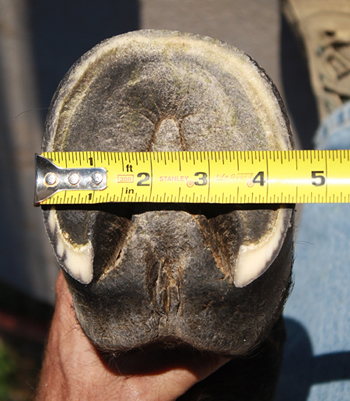
Hoof Width
Hoof Width is defined as: The distance measured at the widest point of the hoof.
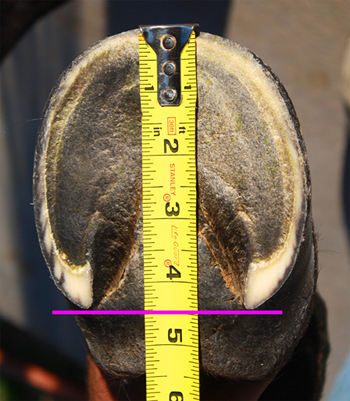
Hoof Length
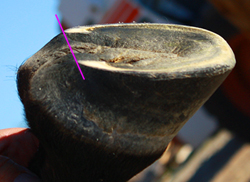
Hoof Length is defined as: The distance measured from the toe to a line drawn between both heels at their rearmost point of weight bearing (colored line above).
CLASSIC and GLUE-ON MODELS
|
| Boot Size | Boot LENGTH | Boot Width |
| 00 | 5″ | 4 1/4″ |
| 0 | 5″ | 4 9/16″ |
| 1 | 5 1/4″ | 4 3/4″ |
| 2 | 5 1/2″ | 5 “ |
| 2W | 5 1/2″ | 5 1/4″ |
| 2WW | 5 1/2″ | 5 1/2″ |
| 4WW | 6″ | 6″ |
|
|
CLASSIC and GLUE-ON MODELS
|
| Boot Size | Boot LENGTH | Boot Width |
| 00 | 127mm | 108mm |
| 0 | 127mm | 116mm |
| 1 | 134mm | 121mm |
| 2 | 140mm | 127mm |
| 2W | 140mm | 133mm |
| 2WW | 140mm | 140mm |
| 4WW | 152mm | 152mm |
Step 1 – Width
The best time to measure hooves for boots is right after a recent “natural” trim featuring a low heel, a short toe and a mustang roll (If your horse has high heels click here High Heels). The mustang roll is important because the inside corners of the Renegade are filleted or rounded to accept the shape of the rounded hoof wall edge(mustang roll). If after trimming, your horse has squared off and sharp hoof wall edges, the boot will not to fit properly which may lead to boot instability. Sharp hoof wall edges are exactly that.. ‘SHARP’.. and can cut the flesh of opposing hooves and damage the hoof boots too. Help stamp out Edward Scissor Hoof! Ask your farrier to perform a proper mustang roll or at the very least, rasp the sharp edge off with a simple bevel shape. Take note that the mustang roll should go all the way to the heels. The hoof in the example photos does not have a mustang roll all the way to the heels in order to improve clarity and understanding of the rearmost point of weight bearing.
Renegade Hoof Boots should not be fitted tightly! The Heel Captivator is the main means of boot retention and not a tight fitting boot shell. A Renegade which fits the hoof perfectly would of course be preferred but… somewhat loosely fitting Renegades are just as likely to be successful in most all situations. One downside to the boots fitting perfectly is they may get too tight as the hoof grows longer between trimming cycles.
Without a doubt, experience has shown that a boot which fits loose is more stable than a boot which fits too tight. If the boot shell does not fit easily onto the hoof, or if you cannot seat the toe into the boot with a tap from the palm or your hand, the boots are too tight.
Understand that as hooves grow longer they also get wider so if the width of your horses hoof is exactly the same as a particular boot size, you should consider the trimming interval of your horse and how long they grow between trims and decide whether or not you should go up one boot size to allow for said growth.
Many boot users groom the hooves with a rasp each time before installing boots which helps to maintain a good fit and promotes a healthy hoof.
Measure the hoof width and compare to the chart above. Select the boot size which is closest to the hoof width without being more narrow. The example hoof in the photo above measures 4-1/2″ wide. The size 0 boot is 4-9/16″ wide which is 1/16″ wider than the hoof. The size 00 boot is 4-3/16″ wide which is 5/16″ more narrow than the hoof. As Renegades should not be fitted tightly, the size 0 boot is the right boot for this hoof width.
When in doubt, size larger. If the hoof measures the same width as the boot width, go to the next size up.
Step 2 – Length
Now compare the measured hoof length to that of the boot length in the chart. The hoof in the example photos above measures 4-1/2″ long, which is 1/2″ shorter than the size 0 boot. This means about 1/2″ of boot base will be sticking out past the rearmost point of weight bearing. For most types of riding, the extra 1/2″ of boot base length is not a problem but as we offer our Cutback Option (Classic model only), which shortens the boot base about 1/4″ (6.5mm) we should add this free option for the example hoof. If I were going to ride this horse fast, or in deep mud, or upon highly technical terrain, or otherwise ride in a very high performance manner, I might select the Max Cutback option which shortens the boot base by about 3/8″ (9.5mm), but….. toe shape can affect actual boot length requirements as a hoof with a large toe bevel or over accentuated mustang roll will not seat all the way forward in the boot and thusly a hoof which measures 4-1/2″ long may not actually have 1/2″ of boot base sticking out past the rearmost point of weight bearing. Also, high heeled and upright hooves (not natural hoof form) have a steeper toe angle which is usually steeper than the toe angle of the boot and therefore the toe of the hoof will not seat all the way forward which also results in the heel sitting closer to the back of the boot base than it would otherwise.
Go to this page for more information about high heels: Hoof Conformation
If you find the boot size selected in step 1 is too short, go up one numerical boot size to gain additional length. This of course will result in some extra boot width but as said previously, the Renegade need not be fitted tightly and for most situations some extra width is OK. If however your situation requires a better fit for width, the boot can be custom fitted using the instructions on this page Boot Fitting Modifications
If you will be riding in deep mud, crossing streams with rocks and boulders or riding fast, it becomes more important to match boot length to hoof length. Horses known to over reach, forge or interfere should also be more closely matched for boot length. While we offer our Cutback options that covers most situations, the boot can also be custom trimmed in the field with hoof nippers and finished smooth with a small rotary grinder like a Dremel Tool.
Cutback Option: (CLASSIC MODEL ONLY) The Cutback Option trims away a certain amount of excess boot length if the hoof length is shorter than the stock boot length. This modification is done in-factory, and has two options offered:
- The Standard Cutback trims 1/4″ off the boot length
- The Maximum Cutback trims 3/8″ off the boot length
Step 2 – Length
Now compare the measured hoof length to that of the boot length in the chart. The hoof in the example photos above measures 4-1/2″ long, which is 1/2″ shorter than the size 0 boot. This means about 1/2″ of boot base will be sticking out past the rearmost point of weight bearing. For most types of riding, the extra 1/2″ of boot base length is not a problem but as we offer our Cutback Option (Classic model only), which shortens the boot base about 1/4″ (6.5mm) we should add this free option for the example hoof. If I were going to ride this horse fast, or in deep mud, or upon highly technical terrain, or otherwise ride in a very high performance manner, I might select the Max Cutback option which shortens the boot base by about 3/8″ (9.5mm), but….. toe shape can affect actual boot length requirements as a hoof with a large toe bevel or over accentuated mustang roll will not seat all the way forward in the boot and thusly a hoof which measures 4-1/2″ long may not actually have 1/2″ of boot base sticking out past the rearmost point of weight bearing. Also, high heeled and upright hooves (not natural hoof form) have a steeper toe angle which is usually steeper than the toe angle of the boot and therefore the toe of the hoof will not seat all the way forward which also results in the heel sitting closer to the back of the boot base than it would otherwise.
Go to this page for more information about high heels: Hoof Conformation
If you find the boot size selected in step 1 is too short, go up one numerical boot size to gain additional length. This of course will result in some extra boot width but as said previously, the Renegade need not be fitted tightly and for most situations some extra width is OK. If however your situation requires a better fit for width, the boot can be custom fitted using the instructions on this page Boot Fitting Modifications
If you will be riding in deep mud, crossing streams with rocks and boulders or riding fast, it becomes more important to match boot length to hoof length. Horses known to over reach, forge or interfere should also be more closely matched for boot length. While we offer our Cutback options that covers most situations, the boot can also be custom trimmed in the field with hoof nippers and finished smooth with a small rotary grinder like a Dremel Tool.
Cutback Option: (CLASSIC MODEL ONLY) The Cutback Option trims away a certain amount of excess boot length if the hoof length is shorter than the stock boot length. This modification is done in-factory, and has two options offered:
- The Standard Cutback trims 1/4″ off the boot length
- The Maximum Cutback trims 3/8″ off the boot length
Go to this page for more information about high heels: Hoof Conformation
If you find the boot size selected in step 1 is too short, go up one numerical boot size to gain additional length. This of course will result in some extra boot width but as said previously, the Renegade need not be fitted tightly and for most situations some extra width is OK. If however your situation requires a better fit for width, the boot can be custom fitted using the instructions on this page Boot Fitting Modifications
If you will be riding in deep mud, crossing streams with rocks and boulders or riding fast, it becomes more important to match boot length to hoof length. Horses known to over reach, forge or interfere should also be more closely matched for boot length. While we offer our Cutback options that covers most situations, the boot can also be custom trimmed in the field with hoof nippers and finished smooth with a small rotary grinder like a Dremel Tool.
Cutback Option: (CLASSIC MODEL ONLY) The Cutback Option trims away a certain amount of excess boot length if the hoof length is shorter than the stock boot length. This modification is done in-factory, and has two options offered:
– The Standard Cutback trims 1/4″ off the boot length
– The Maximum Cutback trims 3/8″ off the boot length
Availability and Sales
Place An Order Here
Or Call (888) 817-4794
More Detailed Information
Understanding Hoof Length and the Rearmost Point of Weight Bearing
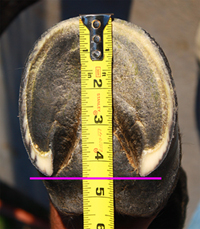
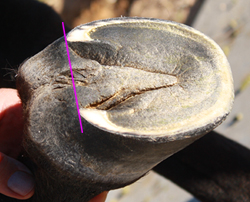
It’s easy to see and understand hoof width but hoof length is tricky because we must be able to determine the rearmost point of weight bearing at the heels. In the photos above I sprayed a light coat of black lacquer paint onto the bottom after which I drew the smooth side of my rasp across the heels to remove the paint and some hoof wall. Doing this served to provide a clean flat surface at the heels with the paint improving contrast. As you can clearly see, the rearmost point of weight bearing is at the colored line drawn across the back of the heels. If you have trouble projecting an imaginary line onto your tape measure, you can apply a piece of masking tape or duct tape onto the hoof with the back edge of the tape aligned with the heel.
Another way to look at this is to imagine for a moment you applied wet paint to the bottom of your horses hoof and then walked him across a smooth hard surface. When looking at the hoof prints left behind by the wet paint, the rearmost point of weight bearing would correspond with the rearmost point of the print but not counting any print left by the frog. I’m not recommending you measure the hooves with wet paint, but this example may help you visualize what I’m talking about.
In addition we need to discuss heel shape as most heels won’t be nice and flat with crisp edges as depicted in the photos above. Somewhat rounded off heels are more typical, especially for those horses landing heel first which is natural. Some trimmers will also intentionally round the heels to help promote a heel first landing and to help mimic the rounded heels found in the wild hoof. I’m an advocate of intentionally rounding the heels which I call Reverse Breakover.
Fortunately we do not need to drive ourselves crazy figuring out the exact hoof length. Simply make your best guess as to where the rearmost point of weight bearing would be if the heel were flat and not rounded and this will usually be close enough.
To see larger views of the photos above click here Large Views
To go back to the beginning click here Top
To see information about high heels click here High Heels